
Founded on November 22, 1784, this church was first called the "Church of Christ on Tyger River". It was renamed Padgett’s Creek Baptist Church by 1800.
The Original log building was located about one mile below the resent location.
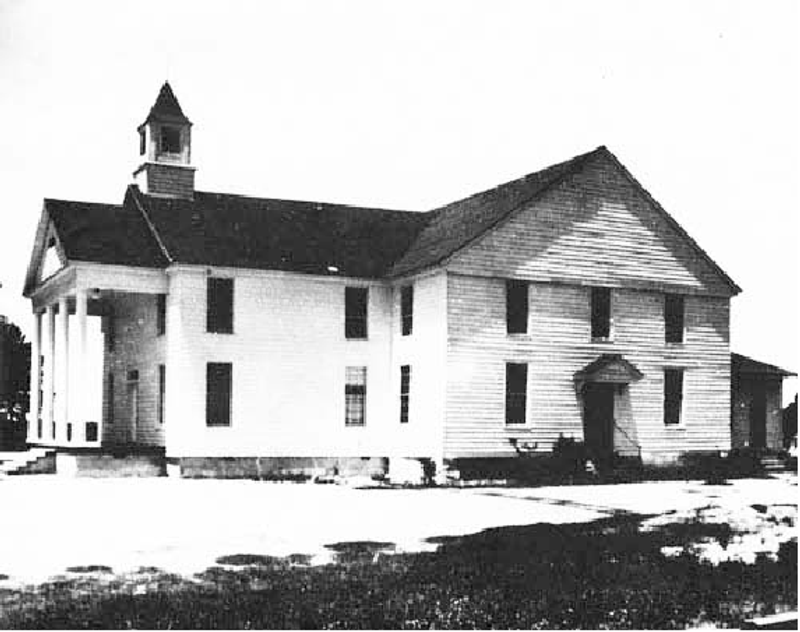
The present building was built 1844-1848 and was listed on the National Register of Historic Places 1971. It is also listed on the South Carolina Register.
In 1844 the church appeared as a plain rectangular two-story building with medium gable roof, six bays deep and three bays wide, on slightly raised brick supports. The interior with a gallery “for use by colored members” was unornamented.
Foresight used in further additions and interior remodeling have maintained the distinct atmosphere of the church.
The present sanctuary still has the wide hand planed boards, a gallery that was used by slaves, and the twelve original columns. Before the baptistery was built inside in 1924, a concrete pool located about 300 yards north of the church was used. The pool was filled with water from a nearby spring.
A front porch was added to the south side of the original building. The walls of which were redone in clapboard to match the additions. The front portico was added in 1958. The porch supported by Doric Columns and a low steeple help present a graceful, modest house of worship. Portions of the gallery were enclosed for classrooms.
Several church meetings were established as arms of Padgett’s Creek: Hebron Baptist (originally called Tinker Creek), Putnam Baptist (originally called Union Meeting House), New Hope Baptist of Cross Anchor and Lower Fairforest Baptist.
The church’s cemetery is adjacent to the church. It was surveyed and divided into five sections, referencing all known graves.
The oldest section is behind the current Fellowship Building. There are Revolutionary War Era markers and many Confederate graves. A monument was erected in 2002 in memory of the unmarked graves.
A map of the cemetery and the alphabetical listings are located on the breezeway at the Fellowship Building.
Padgett’s Creek Baptist Church is important for the detailed manual craftsmanship during its primary construction and for the appropriate additions and alterations which have maintained its architectural integrity. It was an upcountry meeting place for discussion of vital civil matters during the Civil War.
The first Sunday School was held on January 2. 1831. It became a member of the Baptist State Convention in 1841, and the Missionary Society was organized in 1878.
There was a big revival in 1832, and more than 130 members were received into church fellowship. The church had a Camp Meeting in 1849 which lasted two weeks and during this time there were received into the church by experience and baptism 67 white and 11 colored members.
During the revival in August 1911 over 50 members were received under the preaching of J. A. Anderson who was pastor.
On August 29, 1851, a Secession Meeting (possibly the first) was held here. Speakers were Senator William H. Gist (later governor of South Carolina) and Congressman Daniel Wallace, who advocated “secession rather than submission.”
Its history is singular for this church provided a special place for Negro members, offering comfort and convenience to all its members. There were Negro members as late as 1872 and their graves may be seen in the cemetery.
You can only imagine how many lives have been touched by this church and its people.
Over 200 years ago, a few people came together. They trusted and prayed and with hard work, God blessed this beautiful building that has withstood much. This building is merely a place to come in unison to worship God.
In 2009 the church voted to build a Family Life Building borrowing $350000 @ 5% interest for ten years. The building was paid in full; the mortgage was burned on November 25, 2012.
Padgett’s Creek Baptist Church has had a long and glorious history. We trust and pray that the church may continue to grow and accomplish even greater things for Christ’s Kingdom in the future.
We have a place for you. Come grow with us!
To God be the glory, great things He hath done.
For More Church History
